
More than it did five years ago. And I think that tells us something really important about how students today think about education and how QS ranking affect student’s decision.
But here is the thing — QS ranking for Indian universities does not come first in the student’s journey. Not even close.
Before Any Ranking, A Lot Has Already Been Decided
By the time a student is googling university rankings, they have already had months of quiet conversations — with themselves, with their parents, with seniors who went before them.
They have figured out what they want to study. They have decided whether they are okay moving away from home or not. They have had the budget conversation. They have watched where their seniors ended up and drawn their own conclusions.
All of that happens before any website is visited. Before any ranking is looked at.
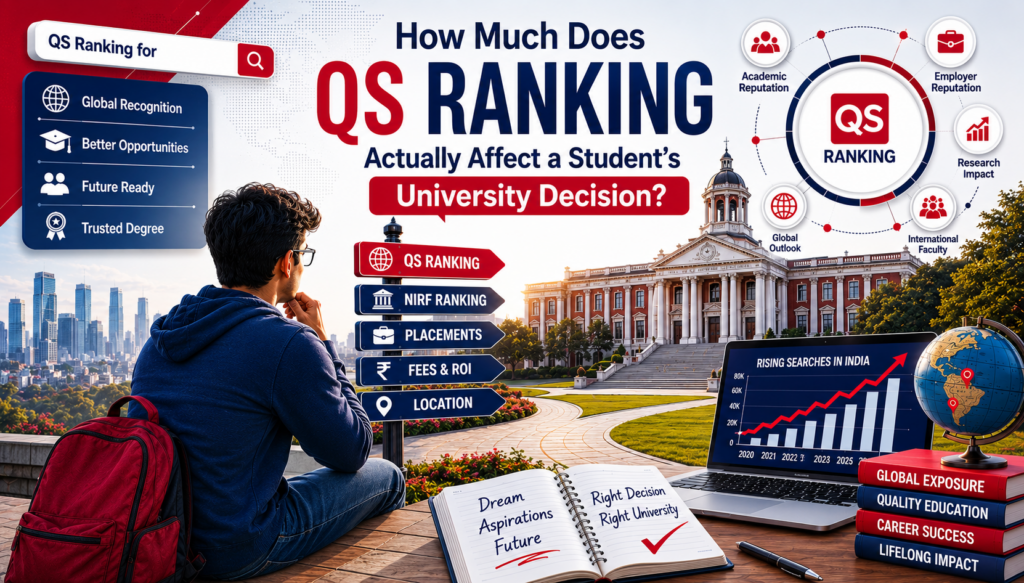
And here is the uncomfortable truth for universities — most of those early decisions cannot be influenced by marketing. The student who has decided they are not moving more than 50 kilometres from home has already ruled you out before they ever saw your ad.
So by the time a student is actively researching — shortlisting, comparing, going deeper — the field has already narrowed. And now they are looking for something specific.
They are looking for validation.
What a Student Is Really Looking For When They Search Rankings
I want to be clear about this because I think it gets misunderstood.
A student searching for rankings is not starting their research. They are trying to confirm something they are already leaning toward.
They want to know — is this place actually good? Will people respect this degree? If I tell someone I studied here, will it mean something?
Rankings are not discovery tools. They are trust signals.
And the trust signal that is growing fastest right now among Indian students is QS.
Why QS Ranking for Indian Universities Is Rising — and Why Now
If you look at Google Trends data for India, searches for “QS ranking” have been growing steadily over the last few years. Searches for “NIRF ranking” — India’s own government ranking system — have not grown at the same rate.
Think about what that means.
NIRF ranks Indian colleges against each other. QS ranking places Indian universities next to Oxford, MIT, and universities in Singapore and Australia. When a student searches QS ranking for Indian universities, they are not asking “which is the best college in my city.” They are asking “how does this place compare to the best in the world.”
That is a completely different question. And it comes from a completely different kind of student.
At the same time, we know that Indian student enrolment in US universities dropped in 2024-25 — graduate enrolment fell around 10%. Some of that is visa policy and uncertainty. Some of it is the sheer cost of living abroad.
But I think there is something else going on.
Aspiration is rising faster than the ability to act on it.
More Indian students than ever want a globally recognised education. Fewer can actually afford to leave India to get it. So they are staying. But they are not lowering their expectations. They are asking Indian institutions to clear a global bar.
The rise in QS ranking searches is what that looks like in data.
Where Are These Searches Actually Coming From?
This is where it gets interesting.
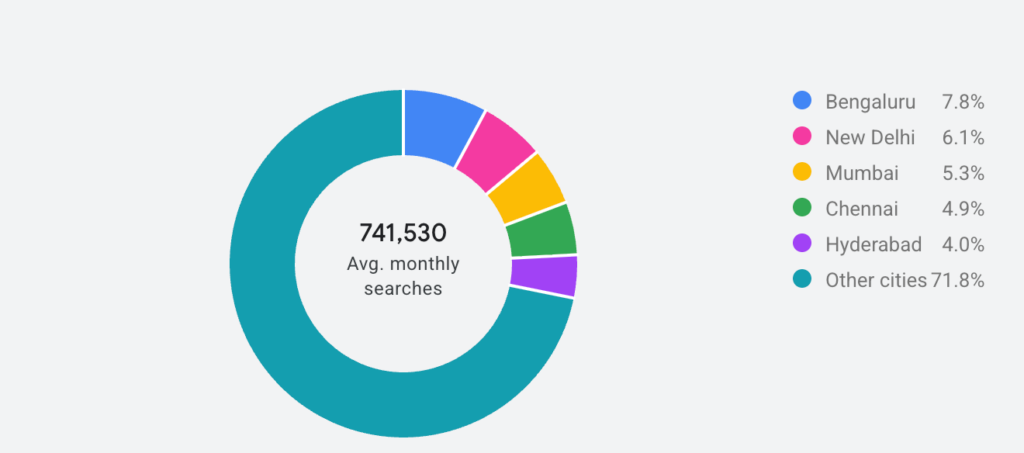
“QS ranking” gets an average of 741,530 searches every month in India. That number alone tells you the scale of student awareness around global rankings.
But look at where those searches are coming from.
Bengaluru leads at 7.8%. New Delhi at 6.1%. Mumbai, Chennai, and Hyderabad follow. These are the cities you would expect — large, urban, aspirational.
And then there is this: 71.8% of searches come from cities outside these five.
Not from the metros. Not from the students universities typically assume are their most ambitious prospects.
From everywhere else.
This matters because most universities market their global ranking credentials to metro audiences — the ones they assume are internationally minded. But the data says the student sitting in a Tier 2 or Tier 3 city is searching QS ranking just as actively. They are comparing. They are aspiring. They are asking the same global questions.
They are just not seeing the answers in the marketing directed at them.
What This Actually Means If You Run a University
The student searching QS ranking for Indian universities is not choosing between two Indian colleges.
They are deciding whether any Indian college is good enough to replace what they could have had abroad.
That is a much harder brief. And honestly, most Indian institutions are not marketing to that student at all.
Most college marketing is built for the student who has already decided to stay in India — comparing fees, placements, location, hostel facilities. That is a real audience. But it is not the only audience anymore.
The QS-searching student wants something different. They want to see international faculty. Research that gets cited globally. Partnerships with universities abroad. Alumni working in global companies. They want proof that choosing India was not settling.
And if your institution has those things but is not talking about them clearly — that student will never know.
Here Is the Part Most People Miss About QS Ranking
Forty-five percent of the QS score comes from just two factors — Academic Reputation and Employer Reputation. Both are determined by surveys. Surveys of academics and employers around the world, asking them which institutions they respect.
Which means 45% of your QS ranking score is literally about how well-known and respected your institution is outside India.
That is not an academic problem. That is a brand problem.
A university that is producing good research but not making it visible. Building global partnerships but not talking about them. Placing graduates in international roles but not tracking or sharing that data. That university is leaving nearly half its QS ranking potential on the table.
Brand building for universities is not a vanity exercise. For any Indian institution serious about global ranking, it is the strategy.
The Competition Is Not Local Anymore
For most of Indian higher education’s history, a college competed with other colleges in the same city. The student’s choice set was limited by what was practically accessible.
That is not true anymore.
A student in Lucknow or Coimbatore can compare your institution to universities in Canada, Australia, and the UK in fifteen minutes on a phone. The benchmark they are using is global. The choice set is global.
QS ranking for Indian universities is not a prestige exercise for institutions that already have everything. It is increasingly the filter through which the most aspirational students — the students every university most wants — are deciding who even makes the list.
The universities that understand this now will be positioned for a student profile that is only going to grow.
The ones still competing only on local terms will find themselves invisible to exactly the students they are trying to attract.
Sources: QS World University Rankings Methodology | Google Trends India | IIE Open Doors Report 2024-25 | AISHE 2021-22, Ministry of Education, Government of India