
For all the Admission Managers out there, here’s a quick way to get leads that actually converts into admission — without spending an extra penny on advertising.
It requires one small change to your landing page and another to how your digital campaigns are optimized.
If you’ve ever looked at your marketing numbers and wondered:
“Why are we spending so much money generating leads when such a small percentage become serious applicants?”
This is worth looking at.
There are multiple ways to improve lead-to-application and lead-to-admission conversion, but let’s talk about one change that’s relatively simple to implement.
The Problem Isn’t Always Your Ads. It’s What You’re Asking the Algorithm to Do.
Think about how most university lead-generation campaigns work today.
Your marketing team runs advertisements on Google and Meta.
Someone clicks the advertisement.
They reach your landing page.
They submit an enquiry.
And Google or Meta records:
Conversion ✓
Sounds right.
Except there’s a problem.
Your campaign has been told that its objective is to generate leads.
So the algorithm tries to find more people who behave like the people who have already become leads.
But what if many of those people were just exploring?
Maybe they filled out forms for five different universities.
Maybe they weren’t eligible for the program.
Maybe they entered an incorrect phone number.
Maybe they never answer your counsellor’s calls.
As far as the advertising platform is concerned, they were still successful conversions.
The platform doesn’t automatically know that your admissions team considers them poor-quality leads.
And that’s where the problem begins.
You’re essentially teaching the algorithm:
“Find me more people like these.”
And it does.
Your lead numbers increase.
Your CPL might even decrease.
The dashboard looks great.
But your admissions don’t necessarily increase with it.
Why Not Optimize for Applications Instead?
That’s the obvious next question.
Instead of telling Google:
Find me people who will become leads.
Why not tell it:
Find me people who will actually apply.
That’s absolutely an option.
If your institution captures application data in its CRM, that downstream data can be fed back into your advertising platforms using the appropriate offline/CRM conversion integrations.
Instead of optimizing towards everyone who submitted an enquiry, your campaigns can learn from people who progressed further and became applicants.
That’s a much stronger signal.
But there’s another challenge.
Applications Can Be Too Far Down the Funnel
Machine-learning-based advertising needs sufficient conversion data to learn patterns and optimize reliably.
A large university generating a high volume of applications can potentially use applications as its primary optimization signal.
But what about an institution generating only a handful of applications each day?
There may simply not be enough application conversions to use that event as the campaign’s only optimization signal consistently.
So you end up stuck between two options.
Leads: Plenty of data, but questionable quality.
Applications: Great quality, but potentially not enough data.
What do you optimize for?
Find the Signal Between a Lead and an Application
The answer could be:
Verified Leads.
And here’s the interesting part.
Your university might already be collecting them.
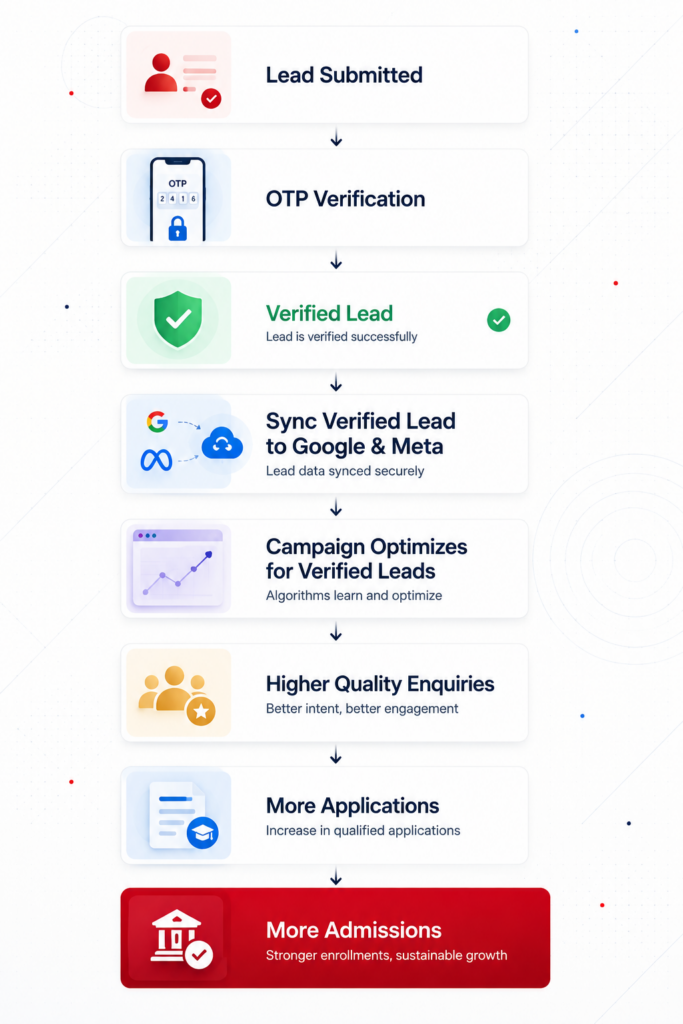
Many universities already ask prospective students to verify their phone number or email address during the enquiry/application journey.
A student submits their details.
They receive an OTP.
They enter the OTP.
Their contact information is verified.
If you’re already doing this, great.
But ask your marketing team one more question:
“Are our Google and Meta campaigns optimizing for these verified leads?”
Because having verification on your website and using verification as a campaign signal are two different things.
Turn “Verified Lead” Into a Conversion Event
If you aren’t currently verifying leads, introduce a verification step after the enquiry form.
For example:
Student submits enquiry
↓
Receives OTP
↓
Verifies phone/email
↓
Becomes a Verified Lead
That extra step creates friction, but in this case, a little friction will help you generate leads that converts into admission.
Someone willing to verify their contact information has demonstrated more intent than someone who simply filled out a form.
It can also help filter out some submissions containing incorrect or unusable contact information.
Now comes the important part.
Send that successful verification event back to your advertising platforms as a conversion signal.
Instead of treating every enquiry equally, you now have a funnel that looks like:
Lead → Verified Lead → Application → Admission
And you can optimize campaigns toward the Verified Lead event where appropriate.
You’re essentially telling the platform:
“Don’t just find me students who submit forms. Find me more students who are likely to verify their interest.”
That’s a very different instruction.
Your Lead Numbers Might Go Down — And That’s Okay
This is where Admission Managers and marketing teams need to align.
Once you start focusing on verified leads, your headline lead volume may decrease.
That’s not necessarily bad news.
If you previously generated:
1,000 Leads → 70 Applications
and a revised approach gives you:
700 Leads → 110 Applications
which campaign would you rather have?
The goal was never to generate leads.
The goal was to generate admissions. At ClassFull, we have been using this optimization technique for multiple universities, and have seen minimum of 10% increase in qualified leads.
Lead volume is only useful when those leads have a reasonable probability of progressing through the funnel.
One Question to Ask Your Marketing Team
At your next marketing meeting, don’t only ask:
“How many leads did we generate?”
Ask:
“What conversion event are our campaigns actually optimizing for?”
If the answer is simply “Lead Submitted,” look one step deeper into your funnel.
You might already have a better signal sitting there.
Verified Leads.
Use it.
Because sometimes improving admissions doesn’t require increasing your advertising budget.
It requires teaching the algorithm what a better lead looks like.