Right after the big milestone of 10th grade, the next question that lingers in the minds of most ambitious Indian students and their parents is: What next?! And perhaps, this is where a higher education marketing strategy needs to begin too. A strong higher education marketing strategy should begin well before admissions open. Students start discovering, evaluating, and shortlisting institutions months before they apply, which means universities need to build awareness, trust, and consideration earlier in the student decision journey.
I’ve seen and heard these conversations frequently play out between parents and their Class 11 children: Which course should I pursue? Which colleges should be on my radar? Which entrance exams should I get coached for? Should I study in my home city or explore student life in a University away from home? And so much more.
What’s interesting is that these conversations begin way before (almost a year, or even earlier sometimes) the student starts applying to institutions. Yet, how many universities and colleges have we come across that are meaningfully part of these conversations at this stage?
Simply put, students start choosing early, while Institutions often start marketing late.
Why Does Higher Education Marketing Often Start Too Late?
Most higher education institutions have conventionally built their marketing communications around a familiar set of messages:
- Rankings and accreditations (Indian and Global)
- Placements and packages
- Programmes and specialisations
- Application deadlines
- Entrance exam dates and result announcements
- Admissions Closing Dates
A large part of this communication is skewed towards the months of March-June of that particular admissions year. Whether on social media, in newspapers, on hoardings in prime locations, or even in the mailboxes and WhatsApps of students and parents, Institutions largely drop by across various communication channels to remind students and parents solely of their admissions closing dates.
There is inherently nothing wrong with this. While this might still work for a few highly ranked national institutions, with limited seats and high cut-offs, the important question is whether this is when the student’s decision journey actually begins, and whether and how a student can then discover Institutions that they aren’t aware of.
The Admissions Calendar And Student Decision Journey Are Different
Today, the Admissions calendar and the Student decision-making calendar are different. There are fewer overlaps between the two. Insights shared during a Google Education Insights session on the higher-education decision journey indicated that students progressively narrow their consideration set to only around 3-4 institutions.
In reality, this is how a typical student journey would look:
A Class 11 student may have initially explored several possibilities. Over time, conversations with parents, entrance-exam preparation, online research, social media, peers, counsellors, campus visits, and other influences would have led to reducing that universe. By the time this student reached the application stage, the question would no longer have been “Which universities should I consider?”, but it may have become, “Which of these 3–4 universities should I finally apply to?”
In such a reality, if an institution hasn’t entered that consideration set early enough, winning the student’s attention during peak admission season becomes significantly harder, and comes at a way higher cost and effort.
Why Early Student Discovery Matters For Higher Education Institutions
On one hand, where calendars don’t match, there’s also the other question of how students discover the Institutions they don’t already know.
Today’s Indian higher education ecosystem is far more competitive, cluttered, and complex than it was a decade ago. According to the 2023-24 AISHE report, there are 1,289 Universities/University level Institutions, 48,246 colleges, and 15,221 Standalone Institutions. The same report records around 4.5 Cr students enrolled in higher education in that year. The scale clearly illustrates how crowded the Indian higher education market has become. With thousands of institutions, with different student intake capacities, competing to win the attention of the same set of students, simply being visbile when admissions open may no longer be enough. In such a congested ecosystem, how does a student then discover:
- An institute closer to home that could be a great fit for them?
- An institute with exceptional faculty in the program they’re considering?
- An institute offering learning experiences that prepare students for real-world careers?
- An institute doing interesting research in the area of their interest?
- An institute with a student experience they might flourish in?
- A program they hadn’t considered, but which aligns well with their interests?
Many institutions have several compelling stories to tell. However, the problem is that students often encounter these stories too late, or never.
How Can Institutions Build Student Consideration Earlier?
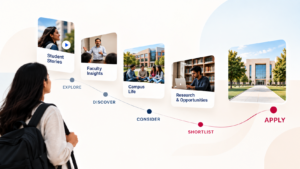 Considering all this, what if Institutions started helping before they started pitching for applications?
Engaging students earlier doesn’t mean running “Admissions Open” ads for the whole twelve months. In fact, it should almost mean the opposite. It should mean understanding the questions students and parents ask at different stages of the journey, and creating useful content that helps them make better decisions. It could be as simple as:
- A social media video of a current student sharing how they chose their course, prepared for admission, and what their university experience has so far been like.
- An online webinar with a faculty member guiding
Class 11 and 12 students to identify which programs could align with their interests and career aspirations. - A website article written by an alumnus speaking about the role the institution’s education played in shaping their career decisions.
- An email for parents explaining hostels, safety, infrastructure, student support, and life away from home.
- A thought leader article by an academic leader sharing the research ambitions and industry collaborations that the Institute’s faculty and students are trying to solve.
None of these communication pieces necessarily need to end with an Apply Now button. Their primary job is to be useful and to win the trust of the students and parents, who are in their higher education decision-making journey. Content should thus start building preference, and paid marketing can amplify it.
How Brand Marketing Makes Performance Marketing Work Better
When a strong foundation of awareness and trust has already been built through brand marketing, performance marketing starts working better.
Students who already know the Institute, understand what makes the Institute different, and are able to visualise what student life at the Institute could look like, are already looking forward to that Applications Open notification. When interacting with performance marketing ads, the conversions of such students start kicking in quicker than those who wouldn’t have gone through this experience. For these students, performance marketing is capturing existing consideration rather than trying to create awareness, build trust and drive an application at the same time.
This is where a multi-touchpoint, round-the-year higher education marketing strategy becomes powerful. It progressively moves a student from Knowing to Considering to Choosing an Institute.
Being Chosen Begins Long Before Applications Open
In short, an Institution’s journey to being chosen by a student begins long before applications open. It begins with being known, building trust, and earning the right to be considered well before the typical admissions season.
Frequently Asked Questions
When should universities start marketing for admissions?
Universities should keep brand marketing campaigns always ON. The objective is to start building awareness and consideration before admissions open, when students first begin exploring courses, careers, and institutions. Admissions-season campaigns can then focus more effectively on converting existing consideration into applications.
Why is brand marketing important in higher education?
Brand marketing helps an institution become known, understood, and trusted before a student is ready to apply. It gives prospective students and their parents reasons to include the institution in their consideration set, creating a stronger foundation for subsequent admissions and performance marketing.
How can universities engage prospective students before admissions open?
Universities can use student stories, faculty-led guidance, alumni experiences, programme and career content, campus-life information, parent-focused communication, research stories, thought-leader articles, and other useful resources that answer the questions students and their parents have during different stages of their decision journey.